




Retrocalcaneal Bursitis Treatment in Sydney
Investigation and Treatment of Pain at the Back of the Heel
Retrocalcaneal bursitis involves irritation of the small bursa positioned between the Achilles tendon and the back of the heel bone. Symptoms can develop when compression, mechanical loading and tissue tolerance become mismatched. Investigative clinical assessment and functional biomechanical analysis are used to identify the structures involved and the mechanical and loading patterns maintaining irritation at the back of the heel.
What Is Retrocalcaneal Bursitis?
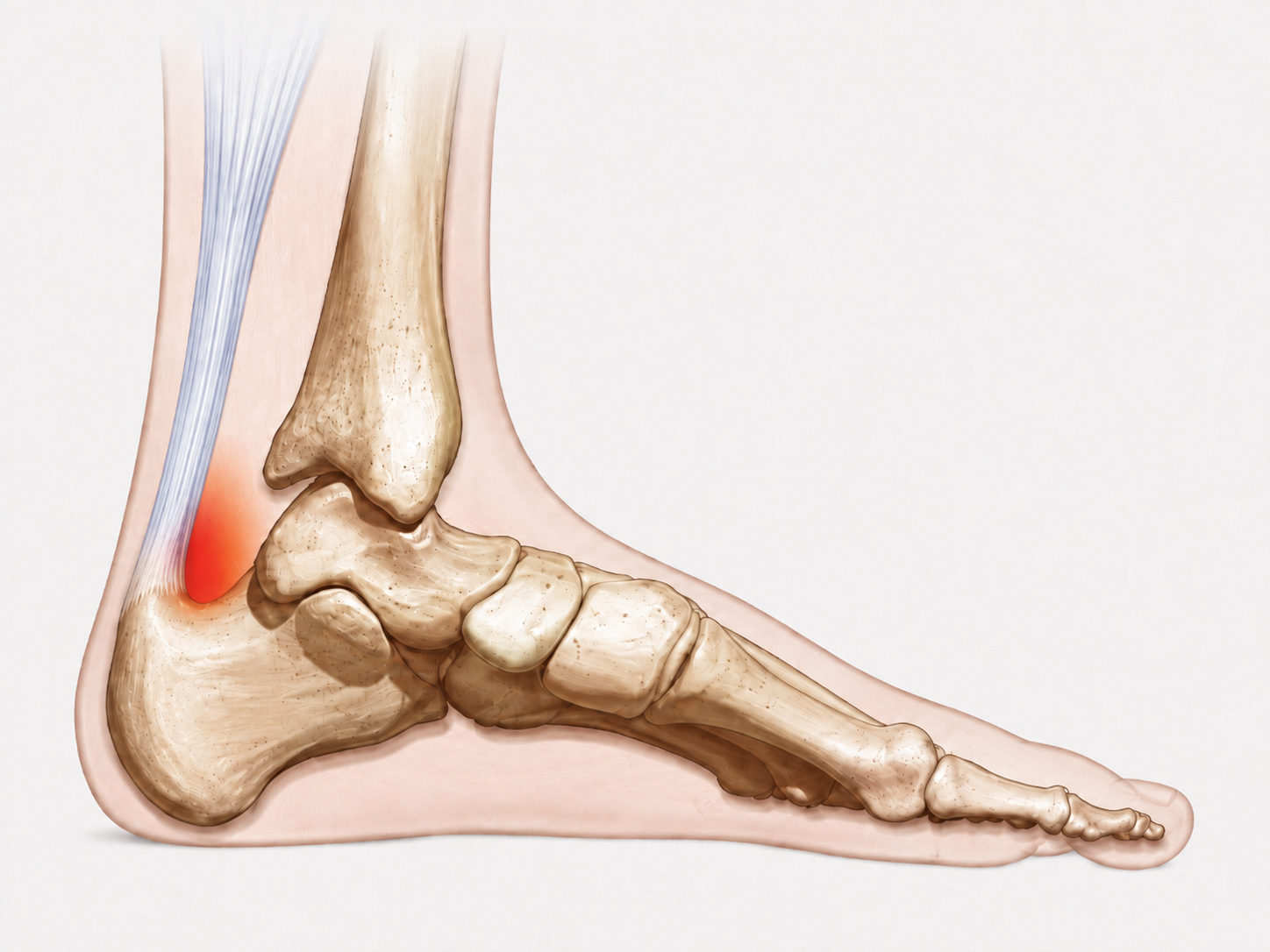
A bursa is a small fluid-filled structure designed to reduce friction between neighbouring tissues. The retrocalcaneal bursa sits deep at the back of the heel, between the Achilles tendon and the posterior surface of the calcaneus.
When this region is repeatedly compressed or mechanically irritated, the bursa can become painful and inflamed. This can produce a deep ache or tenderness at the back of the heel, particularly with walking, running, uphill activity or footwear that places pressure around the posterior heel.
Symptoms of Retrocalcaneal Bursitis
Symptoms vary according to the degree of irritation, the structures involved and the mechanical environment around the back of the heel.
Deep Posterior Heel Pain
Pain is commonly felt deep at the back of the heel, immediately in front of the Achilles tendon insertion.
Footwear Pressure
Shoes with firm heel counters can increase compression around the posterior heel and aggravate symptoms.
Walking and Running Pain
Symptoms may increase during walking, running, hills or activities involving repeated ankle movement and posterior heel loading.
Morning Stiffness
Some patients report stiffness or discomfort during the first few steps after rest, particularly when adjacent Achilles tissue is also irritated.
Local Swelling
Swelling or fullness may develop around the back of the heel when the tissues become persistently irritated.
Achilles Involvement
Retrocalcaneal bursitis can occur alongside insertional Achilles tendinopathy and posterior calcaneal prominence.
The Bursa Does Not Function in Isolation
Identifying bursitis describes the painful structure. It does not necessarily explain why that structure remains irritated.
Persistent symptoms can reflect the interaction between footwear, ankle function, calf mechanics, foot mechanics and repeated loading through the posterior heel. More than one mechanical driver can be present at the same time.
Understanding What Is Loading the Back of the Heel
The investigation considers the mechanical environment surrounding the symptomatic heel rather than assessing the bursa as an isolated structure.
Footwear
Heel-counter shape, shoe stiffness, heel height, cushioning and rocker geometry can alter pressure and movement around the posterior heel. Footwear can therefore influence both direct compression and the mechanical demand placed through the Achilles-bursa complex.
Calf and Ankle Function
Restricted ankle movement and increased tension through the calf-Achilles complex can change the way the posterior heel is loaded during walking and running. Calf function is assessed in relation to movement, timing and the individual presentation.
Foot Mechanics and Asymmetry
Foot posture, rearfoot movement, arch behaviour and side-to-side asymmetry can influence the direction and magnitude of forces passing through the heel and Achilles insertion.
Activity and Loading Exposure
Changes in walking, running, hills, training volume or repetitive activity can exceed the current tolerance of the tissues around the posterior heel.
Occupational and Surface Loading
Prolonged standing, repeated walking, stairs and harder working surfaces can contribute to cumulative loading when exposure exceeds tissue tolerance.
Posterior Heel Structure
The shape of the posterior calcaneus and the presence of a bony prominence or posterior heel spur can reduce available space around the bursa and increase compression in certain footwear or ankle positions.
Mechanical Diagnosis Before Treatment
Pain at the back of the heel can involve several neighbouring structures. Retrocalcaneal bursitis may occur independently or alongside insertional Achilles tendinopathy, posterior calcaneal prominence or irritation of the superficial tissues behind the Achilles.
Assessment therefore begins by identifying which structure is painful and why it is being mechanically irritated.
Assessment May Include
- Clinical localisation of the painful structure
- Achilles tendon and insertion assessment
- Calf and ankle function
- Foot posture and rearfoot mechanics
- Walking and functional movement assessment
- Side-to-side mechanical comparison
- Footwear assessment
- Review of activity and occupational loading
A Clinic Built Around Heel and Rearfoot Pathology
Sydney Heel Pain Clinic has treated more than 7,000 patients. Our clinical work is focused on heel pain and mechanical foot conditions, including plantar heel pain, Achilles pathology and pain affecting the back of the heel.
The approach is investigative. The objective is to differentiate the symptomatic tissues, identify overlooked mechanical drivers and determine which changes are relevant to the individual presentation.
Retrocalcaneal Bursitis Treatment
Treatment is selected according to the pathology identified and the mechanical presentation. The objective is to reduce irritation of the bursa while modifying the loading patterns that are preventing the region from settling.
Footwear Modification
Footwear may be changed when heel-counter pressure, shoe geometry or insufficient mechanical assistance is contributing to compression around the posterior heel.
Calf and Lower-Limb Management
Calf and ankle management is prescribed according to the mechanical findings. The objective is not simply to strengthen or stretch the calf, but to address the specific functional restriction or loading pattern identified during assessment.
Mechanical Modification
Temporary heel lifts, footwear changes or other mechanical modifications may be used to reduce compression and alter load through the Achilles-bursa complex while symptoms settle.
Activity and Load Modification
Walking, running, hills and occupational exposure may require temporary adjustment when cumulative loading is exceeding the tolerance of the irritated tissues.
Shockwave Therapy
Shockwave therapy may be considered when clinically appropriate, particularly when chronic posterior heel symptoms coexist with Achilles insertion pathology. Its use depends on the tissues involved and the stage of the condition.
Custom Orthoses
When foot mechanics are contributing to posterior heel loading, custom orthoses may be designed to alter specific mechanical forces. Devices are modelled using CAD and 3D printed in-house, allowing the orthotic geometry and design parameters to be reviewed and refined.
Retrocalcaneal Bursitis FAQs
Where is retrocalcaneal bursitis pain felt?
Pain is usually felt deep at the back of the heel, between the Achilles tendon and the heel bone. The exact location is important because several different structures can produce posterior heel pain.
Is retrocalcaneal bursitis the same as Achilles tendonitis?
No. They involve different anatomical structures. However, retrocalcaneal bursitis and insertional Achilles tendinopathy can occur together because the structures occupy the same posterior heel region and are exposed to related mechanical forces.
Can shoes cause retrocalcaneal bursitis?
Footwear can be an important mechanical driver. A firm heel counter can directly compress the posterior heel, while shoe geometry can also alter loading through the Achilles tendon and surrounding tissues.
Can a heel spur be involved?
A posterior calcaneal prominence or spur can reduce space around the Achilles insertion and retrocalcaneal bursa. The presence of a spur does not automatically establish the source of pain, so the surrounding soft tissues and mechanical presentation still require assessment.
Do I need a GP referral?
No GP referral is required for a private podiatry appointment. Patients attending under an eligible Medicare referral plan will require the appropriate GP documentation.
Clinical Appointments for Pain at the Back of the Heel
Appointments are available at Sydney CBD, Miranda, Crows Nest and Parramatta. Bring the footwear you use most frequently, including work, walking and exercise shoes where relevant.