



Sever’s Disease Treatment in Sydney
Heel Pain in Growing Children
Sever’s disease is a common cause of heel pain in active, growing children. It affects the growth plate at the back of the heel bone, where repeated traction and impact can exceed the tolerance of the developing tissue. Assessment considers growth, activity, footwear, calf function and foot mechanics to identify the loading patterns contributing to the child’s heel pain.
What Is Sever’s Disease?
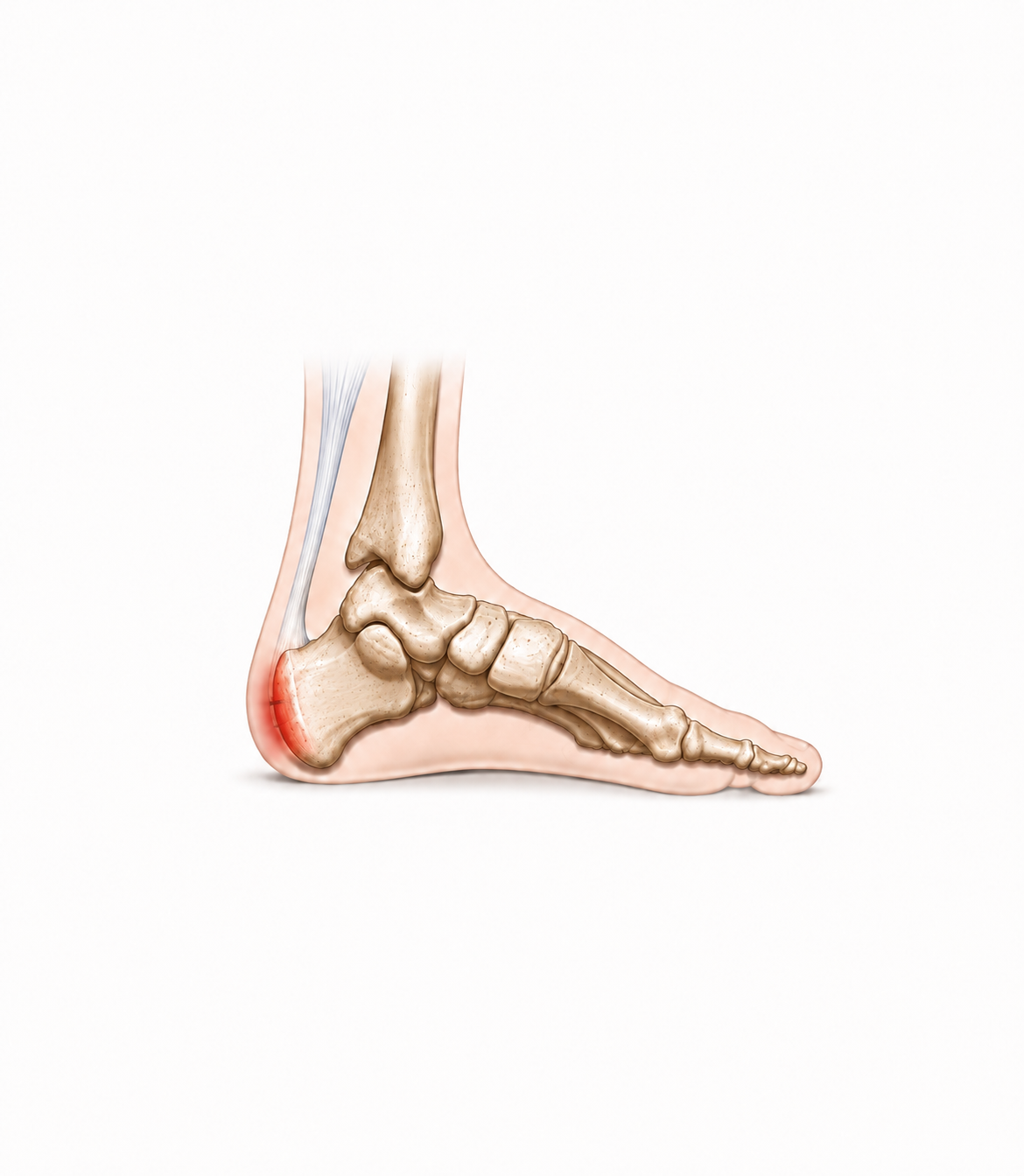
Sever’s disease, also known as calcaneal apophysitis, is irritation of the developing growth plate at the back of the heel bone. It occurs in children whose calcaneus has not yet fully matured.
The Achilles tendon attaches close to this developing region. During periods of growth, sport and repetitive activity, the growth plate can become exposed to repeated traction and impact. If this mechanical demand exceeds the tolerance of the developing heel, pain can develop.
Sever’s disease is therefore different from the common causes of heel pain seen in adults. The child is experiencing pain from a developing skeletal structure exposed to mechanical load.
Symptoms of Sever’s Disease
Symptoms commonly develop during periods of increased activity or growth and can affect one or both heels.
Back of Heel Pain
Pain is usually felt around the posterior and lower part of the heel, corresponding with the developing calcaneal growth plate.
Pain During Sport
Running, jumping and repeated changes of direction can increase mechanical demand through the heel and aggravate symptoms.
Pain After Activity
Some children complete their activity but experience increasing heel pain afterwards or later in the day.
Heel Tenderness
The back and sides of the heel may become sensitive when pressure is applied around the calcaneal growth plate.
Altered Walking
When symptoms increase, children may limp, shorten their stride or alter the way they load the painful heel.
One or Both Heels
Sever’s disease can occur in a single heel or affect both heels simultaneously, particularly during periods of rapid growth and high activity.
Growth Creates a Different Mechanical Environment
During skeletal growth, the heel contains a developing region of bone that has not yet reached maturity. At the same time, active children may be exposing the heel to substantial repetitive forces through running, jumping and sport.
Growth is part of the clinical picture, but it does not act in isolation. The amount of activity, footwear, calf function, foot mechanics and playing surfaces can all influence the mechanical demand placed through the developing heel.
Understanding What Is Loading the Heel
Assessment considers the mechanical environment surrounding the child’s heel and the factors increasing repetitive load through the developing growth plate.
Growth
Symptoms commonly appear during periods of skeletal growth. Changes in bone length and lower-limb mechanics can temporarily alter the relationship between the heel, Achilles tendon and calf complex.
Sport and Activity
Running, jumping, sprinting and repeated changes of direction increase loading through the heel. Training frequency and multiple sporting commitments can create substantial cumulative exposure.
Footwear
Cushioning, heel height, shoe stiffness and overall footwear geometry influence the forces reaching the heel. Football boots, school shoes, running shoes and casual footwear can expose the heel to very different mechanical environments.
Calf and Ankle Function
Calf tightness and restricted ankle movement can increase traction through the Achilles-calcaneal complex. This becomes particularly relevant when combined with rapid growth and repetitive sporting activity.
Foot Mechanics
Foot posture, rearfoot movement and arch behaviour can alter the way forces are transferred through the heel during walking and running. Side-to-side differences may also influence symptoms.
Playing Surfaces
Hard courts, synthetic surfaces, firm playing fields and repeated training on harder ground can increase cumulative impact through an already sensitive heel.
Mechanical Assessment Before Treatment
Heel pain in a child should not automatically be attributed to Sever’s disease simply because the child is growing. The location of pain, clinical presentation and mechanical findings need to be considered together.
Assessment is used to establish whether the calcaneal growth plate is involved and identify which loading patterns are contributing to irritation of the heel.
Assessment May Include
- Clinical localisation of heel pain
- Calcaneal growth plate assessment
- Calf and ankle function
- Foot posture and rearfoot mechanics
- Walking and functional movement assessment
- Side-to-side mechanical comparison
- School and sporting footwear assessment
- Review of sport and weekly activity exposure
A Clinic Built Around Heel Pain
Sydney Heel Pain Clinic has treated more than 7,000 patients. Our clinical work includes heel pain affecting adults, adolescents and growing children.
Sever’s disease requires a different approach from adult heel pathology. The developing growth plate, stage of growth, sporting exposure, footwear and lower-limb mechanics all need to be considered when determining how the heel is being loaded.
Sever’s Disease Treatment
Treatment is directed towards reducing mechanical stress through the painful growth plate while allowing the child to remain appropriately active wherever possible.
Footwear Modification
School shoes, sporting shoes and everyday footwear are assessed for cushioning, heel height, stiffness and mechanical suitability. Footwear changes can substantially alter load through the symptomatic heel.
Calf and Lower-Limb Management
Calf and ankle management is selected according to the child’s functional findings and stage of growth. The objective is to address relevant restriction without unnecessarily increasing load through an already sensitive heel.
Mechanical Modification
Heel lifts, cushioning or other temporary mechanical modifications may be used when appropriate to reduce traction and impact through the painful calcaneal growth plate.
Sport and Load Management
The total weekly load is considered rather than assessing a single training session in isolation. Training, school sport, weekend competition and other physical activity may all contribute to cumulative heel loading.
Foot Mechanics
Where foot mechanics are increasing load through the heel, temporary or longer-term mechanical support may be considered according to the individual presentation.
Custom Orthoses
Custom orthoses may be considered when specific foot mechanics are contributing to persistent heel loading. Devices are modelled using CAD and 3D printed in-house, allowing the orthotic geometry and design parameters to be matched to the child’s mechanical requirements.
Sever’s Disease FAQs
What age does Sever’s disease occur?
Sever’s disease occurs while the calcaneal growth plate is still developing. The exact timing varies between children because skeletal maturation does not occur at exactly the same chronological age.
Can Sever’s disease affect both heels?
Yes. Symptoms can affect one or both heels. Even when both heels are painful, the severity and mechanical findings may differ between sides.
Does my child need to stop sport?
Not necessarily. Activity decisions depend on pain severity, the child’s walking pattern, sporting load and clinical findings. In many cases, the objective is to modify the mechanical environment and manage activity rather than automatically stopping all sport.
Does Sever’s disease eventually disappear?
Sever’s disease is associated with the developing calcaneal growth plate and does not continue once this region reaches skeletal maturity. Symptoms during the growth period can still require management when pain is interfering with walking, school or sport.
Do I need a GP referral?
No GP referral is required for a private podiatry appointment. Patients attending under an eligible Medicare referral plan will require the appropriate GP documentation.
Clinical Appointments for Children With Heel Pain
Appointments are available at Sydney CBD, Miranda, Crows Nest and Parramatta. Bring the child’s school shoes, sporting footwear and everyday shoes to the appointment where possible.