



01
Investigative Assessment
We look beyond the painful area itself to identify the mechanical, functional and activity-related factors that may be contributing to the problem.
Assessment and treatment focused on heel pain, plantar fasciitis, Achilles conditions and persistent foot pain.
With more than 7,000 patients treated, Sydney Heel Pain Clinic is led by Sports Podiatrist Karl Lockett, former Podiatrist to the Sydney Opera House and university guest lecturer.
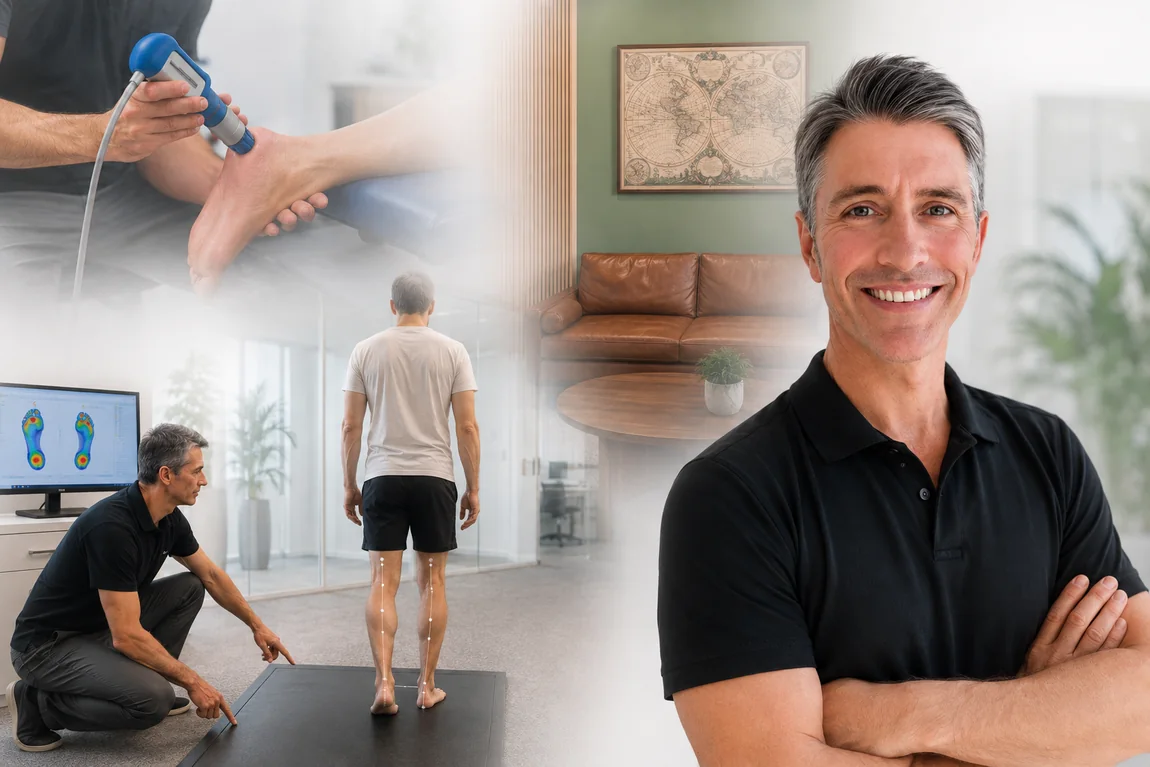
Sydney Heel Pain Clinic is centred on the assessment and treatment of heel pain and related lower-limb conditions rather than general podiatry.
We look beyond the painful area itself to identify the mechanical, functional and activity-related factors that may be contributing to the problem.
More than 7,000 patients have attended the clinic across a broad range of heel-pain presentations, including persistent and complex cases.
Treatment is selected according to the structures involved, the contributing factors identified and the level of mechanical demand the area can currently tolerate.
The aim is not simply to treat the location of pain, but to understand why the problem has developed, why it may be persisting and what needs to change.
Heel pain is not one condition. The location of pain, the structures involved and the factors maintaining irritation all influence how the problem should be assessed and treated.
Pain predominantly under the heel, often prominent with the first steps in the morning or after periods of rest.
Learn more →Posterior heel pain may involve the Achilles insertion, bursa, posterior calcaneus or surrounding soft tissues.
Learn more →Pain higher through the Achilles region may involve the tendon, retrocalcaneal bursa or other structures around the back of the ankle.
Learn more →Heel spurs may be present with pain, but the spur itself is not always the primary source of symptoms.
Learn more →Heel pain in growing children is assessed in relation to growth, activity, calf function, footwear and mechanical demand.
Learn more →Bursal irritation can occur around the heel and Achilles region and requires different management depending on its location and cause.
Learn more →Not sure which condition fits your symptoms? The assessment begins with identifying the painful structure and the factors that may be preventing it from recovering.
Persistent heel pain often means that something important has not yet been identified, modified or adequately addressed.
The painful structure is only part of the picture. Foot mechanics, footwear, occupational demands, training exposure, calf function, activity levels and repetitive loading patterns may all influence whether irritated tissue is able to recover.
Our assessment is designed to investigate these relationships rather than simply apply another treatment to the painful area.
Cushioning, longitudinal flexibility, torsional rigidity, heel geometry and changes between shoe models are evaluated to determine whether footwear is perpetuating irritation rather than simply whether the shoe feels comfortable.
Foot posture, joint movement, asymmetry and loading behaviour are assessed to determine whether an individual mechanical pattern corresponds with the symptomatic structure.
Ankle movement, calf function and available movement under load are examined to establish whether they are altering mechanical demand through the heel or Achilles region.
Changes in running, walking, sport, training volume, frequency and recovery are analysed rather than assuming that activity itself needs to stop.
Foot positions, postural habits and repeated movements are investigated to identify less obvious sources of tissue irritation. These may occur during work, everyday activity, stretching or attempted rehabilitation without the patient recognising their significance.
More than two decades focused predominantly on heel pain has shaped how we investigate these conditions, how treatment decisions are made, and the order in which they are introduced.
Persistent heel pain often turns on details that are easily overlooked. The questions we ask and the findings we investigate are informed by patterns repeatedly encountered across thousands of heel-pain presentations.
Identifying plantar fasciitis, Achilles tendinopathy or another painful structure does not necessarily explain why it remains irritated. We investigate the mechanical, functional and day-to-day factors that may be maintaining the problem.
Treatment is not simply a list of interventions. Sequence matters. The contributing factors are identified first, then treatment is introduced according to what needs to change, what the tissue can currently tolerate and what should happen next.
When custom orthoses are indicated, clinical decisions continue beyond the foot scan. Orthotic geometry and individual design parameters are evaluated in CAD, produced using in-house 3D printing, and reviewed and refined when required.
The difference is not simply which treatments are available. It is understanding what needs to be addressed, in what order, and why.
There is no single treatment for heel pain. The approach depends on the structure involved, the factors contributing to irritation, how long the problem has been present and what the area can currently tolerate.
Shockwave therapy may be used in selected persistent cases to support tissue recovery. It is introduced as part of the wider treatment plan, rather than used in isolation without addressing the mechanical drivers maintaining the problem.
Calf capacity, ankle function, tendon loading and relevant lower-limb relationships are addressed where assessment indicates they are contributing to demand through the heel or Achilles region.
Modern footwear varies considerably in cushioning, rigidity, flexibility, rocker geometry and heel-to-toe structure. A shoe can feel comfortable yet still increase demand through an irritated heel. Footwear is reviewed where its mechanical characteristics may be influencing symptoms or holding back recovery.
Once a provocative position, movement pattern or repeated mechanical demand has been identified, the relevant behaviour is modified to reduce unnecessary stress on the painful structure. This may involve changing foot position, movement strategy, activity technique or the way a particular task is performed.
Where additional mechanical control is required, custom orthoses can be designed to offload painful structures around the heel. Individual geometry is developed using 3D scanning, CAD modelling and in-house 3D printing.
In more irritable presentations, temporary reduction of mechanical demand, heel lifts or immobilisation may be considered when the tissue requires a period of greater protection before loading is progressed.
Treatment is not automatically escalated. The aim is to use the interventions that are clinically relevant, introduce them at the appropriate stage, and avoid adding treatment simply because it is available.
When custom orthoses are indicated, the clinical decisions continue well beyond the 3D foot scan.
Foot shape is captured digitally, then orthotic geometry is developed in CAD according to the findings from the assessment. Arch profile, heel control, offloading, contour, flexibility and left-to-right differences can all be evaluated individually.
The devices are produced using in-house 3D printing, allowing the design to be reviewed, refined and reproduced without handing clinical control over to an external laboratory.
Digital capture provides the starting geometry for the design.
Individual design parameters are evaluated and adjusted according to the clinical findings.
The final design is produced in-house, keeping manufacture under direct clinical control.
Retained design files allow devices to be adjusted, refined or reproduced when required.
Heel pain has been the clinical focus of Sydney Heel Pain Clinic for more than two decades, across both straightforward and persistent presentations.
Clinical experience across a broad range of heel-pain presentations.
Assessment and treatment are centred on heel and lower-limb pathology rather than general podiatry.
Qualified in 1998, with more than two decades of clinical work focused predominantly on heel pain, biomechanics and persistent lower-limb conditions.
Heel pain assessment and treatment are available across Sydney CBD, Crows Nest, Parramatta and Miranda.
Assessment and treatment are available across four Sydney locations. Choose the clinic most convenient for you.
Pitt Street location for patients working, living or travelling through central Sydney.
View Sydney CBD Clinic →Convenient access for patients across the Lower North Shore and surrounding suburbs.
View Crows Nest Clinic →Heel pain assessment and treatment for patients across Parramatta and Western Sydney.
View Parramatta Clinic →Our Sutherland Shire location providing heel pain assessment and treatment in Miranda.
View Miranda Clinic →Not sure which location to choose? Appointments can be booked online, or you can call our AI receptionist 24/7.
Many patients come to Sydney Heel Pain Clinic after heel pain has persisted despite previous treatment, changes in footwear, rest or attempts to manage the problem themselves.
Patient feedback frequently reflects the value of a more detailed investigation, a clear explanation of the findings and a treatment plan that addresses the individual presentation.
Independent patient reviews provide an insight into the assessment, communication and treatment experience at Sydney Heel Pain Clinic.
Read Our Google Reviews →A few of the questions we are commonly asked by patients before their first appointment.
No. You can book directly with Sydney Heel Pain Clinic without a referral. If you have relevant imaging, reports or previous treatment information, bring these with you where possible.
Medicare may contribute towards podiatry consultation costs if you are eligible and your GP has prepared a Chronic Condition Management Plan.
Private health insurance may also provide a rebate for podiatry consultations, depending on your level of cover.
No. Plantar fasciitis is a major part of the clinic, but we also assess and treat Achilles conditions, posterior heel pain, heel bursitis, heel spurs, Sever's disease and other heel and lower-limb presentations.
Previous treatment can be useful information. Persistent symptoms may indicate that an important contributing factor has not yet been identified, that treatment was introduced in the wrong sequence, or that the painful structure is still being exposed to excessive mechanical demand.
Not necessarily. Custom orthoses are recommended only where additional mechanical control or offloading is considered clinically relevant. They are one treatment option rather than an automatic part of every heel-pain assessment.
No. Shockwave therapy may be used in selected persistent presentations, but it is not used as a standalone solution. Mechanical and functional factors still need to be identified and addressed where relevant.
Choose the location most convenient for you. Appointments are available in Sydney CBD, Crows Nest, Parramatta and Miranda.
If heel pain is persisting, the first step is to identify the structure involved, the factors contributing to irritation and what needs to change.